Sexual extortion (“sextortion”) is an increasingly common form of blackmail that involves threats to expose sexual images.
Every year, thousands of people—most of the teenagers—are threatened with having their most intimate images exposed unless they pay money, send more photos, or give in to other demands. This crime is called sextortion (sexual extortion), and it's grown into one of the fastest rising threats facing young people online. Reports of online enticement to the NCMEC CyberTipline more than doubled from 186,000 in 2023 to 456,000 in 2024, and the FBI issued a national public safety alert about the explosion of sextortion incidents. Read on to find out exactly how sextortion works, what state and federal charges perpetrators face, and what steps victims can take to get help.
Sexual Extortion: How It Happens
Sextortion is a form of sexual exploitation that happens when perpetrators threaten to share sexual images of victims (often minors) to get them to do something like send money, gift cards, or more sexual photos and videos.
How Do Sextortionists Get Sexual Images?
Perpetrators, who may know their victims in real life or interact with them only online, use different methods to get sexual images of their victims, including:
- Manipulation. Perpetrators often connect with victims through social media, gaming platforms, or dating apps. They build trust until they can convince (or coerce) their victims to share nude photos. Or, a perpetrator might convince someone who knows the victim, such as a classmate at school, to share an intimate image.
- Hacking. Some perpetrators hack into their victims’ devices and phones and steal images.
- Revenge porn. Disgruntled ex-partners sometimes threaten to share private sexual images without consent.
- Deepfakes. Increasingly, perpetrators don’t even have to get their hands on an actual nude image or video. Instead, they use AI to create explicit deepfake images.
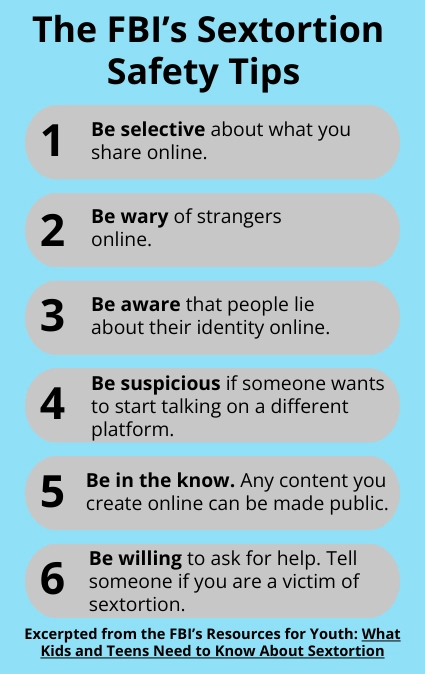
Financial Sextortion
According to Thorn, a technology nonprofit dedicated to combatting child sexual abuse, girls were historically more likely than boys to be victims of sextortion. Sextortionists were more likely to know their victims offline and make personal demands—for more images, sexual acts, or to stay in a relationship.
Since 2022, however, researchers have reported a dramatic rise in financial sextortion. Financial sextortion involves demands for money and overwhelmingly targets boys and young men. According to Thorn, 90% of victims who reported sextortion to the NCMEC CyberTipline between August 2020 and August 2023 were teen boys. Perpetrators in these cases are less likely to know their victims offline. According to the FBI, a “large percentage of financial sextortion schemes originate outside of the United States and primarily in West African countries such as Nigeria and Ivory Coast.”
Is Sextortion a Felony?
Sexual extortion is a crime and most often a felony.
State Laws Targeting Sextortion
Several states have enacted laws specifically targeting sexual extortion, while others prosecute these acts as extortion, sexting, revenge porn, deepfake porn, or child pornography, depending on the age of the victim.
Federal Laws Targeting Sextortion
The federal Take It Down Act addresses sextortion, making it a felony to threaten to publish intimate sexual images to extort, intimidate, or coerce the victim. Depending on the facts of the case, federal prosecutors can also charge sextortionists with statutes prohibiting:
- sexual exploitation of children
- child pornography
- blackmail
- extortion
- stalking
- hacking
- wire fraud, and
- money laundering.
(18 U.S.C. § 873; 18 U.S.C. § 875; 18 U.S.C. § 1030; 18 U.S.C. § 1343; 18 U.S.C. § 1956; 18 U.S.C. § 2251; 18 U.S.C. § 2252; 18 U.S.C. § 2261A; 47 U.S.C. § 223(h) (2026).)
What Is the Punishment for Sextortion?
The punishment for sextortion varies dramatically based on whether the victim is an adult or child and whether the case is prosecuted on the federal or state level.
Federal Penalties for Sextortion Crimes
The federal Take It Down Act makes sextortion a two- or three-year felony. A similar penalty applies to other types of extortion.
Sextortionists who target minor victims could also be charged with producing, possessing, or distributing child pornography (or child sexual abuse material). Federal penalties for child pornography-related federal crimes vary from a minimum of 5 to 40 years in prison.
(18 U.S.C. § 875(d); 18 U.S.C. § 2251(d); 18 U.S.C. § 2252(b); 47 U.S.C. § 223 (2026).)
State Penalties for Sextortion Crimes
Each state has its own penalties for sextortion. Pennsylvania has a specific sexual extortion law. Penalties there range from a first-degree misdemeanor (up to five years prison) for a first offense involving an adult victim to a third-degree felony (up to seven years prison) for cases involving victims who are younger than 18 or intellectually disabled, repeat offenders, or offenders who hold positions of trust or authority over victims. (18 Pa. Cons. Stat. §§ 1103, 1104, 3133 (2026).)
Utah punishes sextortion involving an adult perpetrator and adult victim as a third-degree felony. Aggravated sextortion by an adult is a first- or second-degree felony when the victim is also an adult and a first-degree felony when the victim is a child or vulnerable victim. A conviction for a first-degree felony can mean life in prison. Examples of aggravated sextortion include situations involving:
- weapons or violence
- injuries to the victim
- perpetrators who are strangers to their victims or befriend them to sexually exploit them
- perpetrators with prior sexual offenses, and
- perpetrators who violate positions of trust.
(Utah Code §§ 76-3-203, 76-5b-204 (2026).)
The Cyber Civil Rights Initiative (CCRI) tracks sextortion laws by state. If you have questions about the penalties for sextortion in your state, talk to a local criminal defense lawyer.
What Is a Sextortion Scam?
Most sextortionists target a specific victim, either someone they know or someone they’ve interacted with online. Others cast a wider net in a sextortion email scam.
A sextortion phishing scam goes something like this: You get an email from someone who claims to have installed spyware on your computer or mobile phone. The email typically includes your name, address, and sometimes even a picture of your house. The scammers say they will release embarrassing information about you—such as screenshots of you watching pornography—if you don’t send them money, often Bitcoin or another cryptocurrency.
According to the Electronic Frontier Foundation (EFF), sextortion scammers almost certainly haven’t hacked your computer. They likely found your information in a data breach and are sending a similar email out to potentially millions of people hoping that some will be scared enough to pay up and make the scam profitable. The best way to respond, according to EFF, is to ignore the email and use a password manager to keep your passwords strong. You can also cover your webcam if that brings you peace of mind.
What Should I Do If I Am a Victim of Sextortion?
If you are a victim of sextortion, know that you aren’t alone and you haven’t done anything wrong. Sextortion can make you feel isolated and scared, but it’s not your fault if someone tricks or betrays you. Here are steps you can take to stop sextortion and get help.
Step 1: If You Are at Risk of Suicide, Get Crisis Support
From 2021 to 2025, NCMEC identified 36 teenage boys who took their own lives because they were victimized by sextortion. The 988 Suicide & Crisis Lifeline is available for people in suicidal or substance use crisis or emotional distress and loved ones who want to help them. It's free, confidential, and available 24 hours a day, 7 days a week. To connect with a trained counselor who can help, call or text 988. Or you can text "HOME" to 741741 to confidentially connect with a trained crisis counselor 24/7.
If you aren't in crisis but want someone to talk to about your mental health, you can call a warmline. Warmlines are free, confidential phone lines staffed by real people (not chatbots) who can provide emotional support during hard times.
Step 2: Don’t Pay or Comply With Demands
Don't comply with a sextortionist’s demands. Don’t pay any money or send photos and videos. According to Thorn, cooperating or paying rarely stops the threats. It often just causes perpetrators to increase their demands. The best approach is to stop communicating with the sextortionist right away. If you've already given money or sent photos, it's okay. Just stop communicating and complying moving forward.
Step 3: Don’t Delete Anything
Take screenshots of all your communications with the perpetrator and save your profile and messages to use as potential evidence and then block the perpetrator.
Step 4: Talk With Someone You Trust
Tell the people close to you, like your family, friends, or teachers what you’re going through. To connect with a trained counselor, text THORN to 741741.
Step 5: Make a Report
If you were younger than 18 at the time someone created or shared intimate images of you, contact NCMEC’s CyberTipline. A trained analyst will review your case and provide it to the appropriate agency for possible investigation. Victims of sextortion of any age might also want to report it to a local law enforcement agency or the FBI (call 1-800-CALL-FBI or submit a tip online at tips.fbi.gov). But keep in mind that sharing nude images of minors (including selfies) is illegal, so it’s possible you could face consequences too. Talk to a trusted adult or lawyer if you have any questions.
Step 6: Notify the Tech Platform
Report any threats and images that have been shared to the relevant platform. NCMEC’s removal guide can help you get started.
Step 7: Prevent Images from Spreading
Take It Down is a free service that can help you remove online nude and sexually explicit images that were taken of you when you were under 18. If you were an adult when the images were taken, StopNCII.org can help you get the images removed from some platforms. The CCRI Safety Center has a step-by-step guide to requesting image removal.
Step 8: Change Your Passwords
Make sure your accounts are as secure as possible. Change your passwords and activate the highest security settings.
How to Report Sextortion
Many sextortion victims feel ashamed and don’t want to talk about what’s happening to them, but help is potentially available from local, state, and federal agencies.
Can a Victim of Sextortion Get in Trouble?
Before you report sextortion, take a minute. According to Thorn, some victims of sextortion have gotten help from the police. You are the victim and you've done nothing wrong, but sharing nude photos of minors, even selfies, is illegal and you could potentially face consequences depending on your situation. You should talk to a trusted adult or an attorney before you contact law enforcement.
Reporting Sextortion to Law Enforcement
As noted above, if you were a minor when the image was taken or spread, report the abuse to the CyberTipline. If you prefer to speak to someone, you can call NCMEC’s call center at 1-800-843-5678. NCMEC’s team will review your report and contact the appropriate agency for a potential investigation.
If you are a student, consider reporting the sextortion to your Title IX coordinator or other student support service on your campus.
The FBI has issued many warnings about the dramatic increase in sextortion cases. You can reach out to your local field office for help or file a complaint at the Internet Crime Complaint Center (IC3), the FBI’s central hub for reporting cybercrime. You can also call a state or local law enforcement agency.
Reporting Sextortion to Tech Platforms
Most sextortion happens on social media, gaming platforms, and dating apps. You can report the sextortion to the appropriate tech platform. If the perpetrator has posted explicit images of you, you can ask the platform to take them down. But before you do, preserve all the evidence.
You can find removal procedures for tech companies on their websites. Here are a few of the major platforms: Instagram; TikTok; Snapchat; and Facebook.
Can I Sue Someone for Sextortion?
In addition to requesting criminal charges, many victims want to know if they can sue someone for sextortion. If you file a civil lawsuit you can ask for money to compensate you for things like:
- emotional distress
- lost wages and diminished earning capacity, and
- out-of-pocket expenses like therapy, online content removal, and moving expenses.
Many states and the federal government have laws that allow victims of revenge porn and deepfake pornography to file lawsuits against the people who harmed them. Sextortion victims might be able to use these same laws to get compensation for their suffering. Other potential causes of action in a sextortion-related civil lawsuit include invasion of privacy and intentional infliction of emotional distress.
Examples of Sextortion Cases
Sextortion can happen in many different ways. Here are a few real-world examples.
Hacked by Someone You Know
An early example of sextortion involved Cassidy Wolf. Wolf, who was crowned Miss Teen USA, was attending college in 2013 when she received a threatening email from her former high school classmate, Jared James Abrahams. Abrahams used software to control Wolf's webcam to take nude photos and videos of her. He then threatened to publish them if she didn’t comply with his demands to send more photos or videos. Wolf told her mother, who called the police. Abrahams, who admitted to hacking into as many as 150 online accounts in 2012 and 2013, was sentenced to 18 months in federal prison for one count of hacking and three counts of extortion.
AI-Generated Nudes on Instagram
In January 2024, high school journalists exposed a widespread sextortion scheme involving multiple schools in Aurora, Colorado. Some students were contacted through Instagram by an account that had reportedly gotten nudes of them. Others were invited to join an Instagram "Close Friends List" where explicit photos had been posted. The sextortionists then demanded payment to have the photos removed. At least one of the victims said the image was doctored and it wasn’t them. One of the journalists who worked on the story said the lewd photos were "possibly real, possibly changed."
On December 5, 2024, the Aurora Police Department Internet Crimes Against Children Unit arrested Jamir Deante Bright in connection with the Instagram sextortion scheme. He, along with two minor-aged accomplices, is alleged to have committed child exploitation and criminal extortion. The high school journalists who first broke the Aurora sextortion story are now journalism students at the University of Colorado Boulder.
Catfished by Online Predators
In 2022, Jordan DeMay fell victim to online predators posing as a pretty girl his age. The predators convinced him to share an explicit photo of himself and then threatened to share the picture online unless he paid $1,000. He paid $300, but it wasn’t enough. The predators shared the photo with DeMay's girlfriend, and when he threatened to take his life, they encouraged him to do it.
Tragically, DeMay died of a self-inflicted gunshot wound a mere six hours after he first started communicating with the predators. He was only 17 years old.
The FBI was able to track the predators down in Nigeria. Two brothers, Samuel Ogoshi and Samson Ogoshi, were extradited to the United States and sentenced to 210 months in prison followed by five years of supervised release.
Resources for Victims of Sextortion
If you are a victim of sextortion, you aren’t alone. There are many free, trusted resources available to guide you through the legal and emotional aftermath of sextortion. Here are a few:
- RAINN (Rape, Abuse & Incest National Network): The nation’s largest anti-sexual violence organization operates the National Sexual Assault Hotline. Call 1-800-656-HOPE or chat rainn.org.
- Information and Resources on Sextortion by the American Academy of Pediatrics
- Internet Crimes Against Children Task Force, and
- Nolo’s Resources for Victims of Crime.

In This Article