Understand what counts as gambling, which types are legal, and how state rules affect casinos, betting, and online play.

Gambling is legal in some form across most of the United States—but exactly what counts as legal gambling varies by state. While federal and tribal laws play a role, states generally make the final call on what types of gambling are allowed and how they’re regulated. The result is a complex mix of laws that differ widely depending on where you play.
In This Article
- What Counts as Gambling Under the Law?
- Types of Legal Gambling in the U.S.
- Is Online Gambling Legal?
- What Is the Minimum Age to Gamble?
- Are Office Pools and Home Poker Games Legal?
- Are Fantasy Sports Contests Considered Gambling?
- What Is Illegal Gambling?
- Federal vs. State Gambling Laws and Penalties
- How to Find Out What Types of Gambling Are Legal in Your State
- When to Get a Lawyer or Other Help With Gambling
What Counts as Gambling Under the Law?
In most states, an activity qualifies as gambling if it includes three elements:
- consideration—you pay something of value
- chance—the outcome depends on luck rather than skill, and
- prize—you stand to win money or something valuable.
Everything from an office March Madness pool to slot machines in Las Vegas fits this definition. Federal law provides some oversight, but each state defines and enforces its own gambling rules.
Types of Legal Gambling in the U.S.
Almost every state allows at least one form of gambling. Common forms of authorized gambling include:
- state lotteries and raffles
- tribal and commercial casinos
- charitable gaming and bingo
- horse racing and pari-mutuel betting, and
- sports betting.
But gambling isn't generally legal unless it's both authorized by law and complies with state and local regulations. Any individual or company that wants to operate an authorized form of gambling needs to check to see if and what regulations apply, such as state or local licensing requirements.
Is Online Gambling Legal?
The legality of online gambling also varies by state. Online sports betting is legal in over half of U.S. states, while online casinos (“iGaming”) are legal in only seven states—Connecticut, Delaware, Michigan, New Jersey, Pennsylvania, Rhode Island, and West Virginia (as of early 2026). Online gambling operators must also be licensed by state authorities.
What Is the Minimum Age to Gamble?
The legal gambling age varies by state and gambling type. Most state lotteries set the minimum age at 18. But casinos and sports betting often require players to be 21. Many states have different age minimums for different types of gambling, for instance age 21 for casinos but age 18 or 19 for pari-mutuel bets. Tribal casinos may have different age limits.
Always check both state law and individual venue policies before placing a bet.
Are Office Pools and Home Poker Games Legal?
Most states carve out narrow exceptions for social gambling—such as office pools or home poker games—making them legal. For example, a state might exclude private games, wagers, and bets made in social relationships from the legal definition of gambling. A few states allow low-stakes tournaments to run unregulated, as long as strict rules are followed.
Most neighborhood or office pools won't be on the radar of state gaming commissions. But there's always the chance someone will file a complaint, especially for larger betting pools or tournaments. Organizers should know that most state “gambling exemptions” won’t apply if they impose an entry or seat fee, take a cut of the pot, or allow bets or the prize to exceed a certain amount. These games, bets, or pools cross over into gambling and are subject to state regulations.
Are Fantasy Sports Contests Considered Gambling?
In most of the U.S., paid fantasy sports contests are treated separately from gambling operations. A number of states created new laws to prevent fantasy sports contests from being considered gambling, with some of them also enacting rules and regulations for paid contests. States created these new laws to eliminate the legal uncertainty that persisted as to whether fantasy sports was a game of skill or chance, with the latter considered gambling.
Game of Chance or Skill?
But this issue hasn't been resolved everywhere—fantasy sports contests continue to sit in a legal grey area in certain states. Some states have determined that fantasy sports contests are gambling operations, and others haven't clearly addressed the issue. These legal hang-ups have led some of the big fantasy sports operators to leave certain markets (notably Nevada), and block consumers in some states from participating in online fantasy contests (such as Idaho, Montana, and Washington).
State Regulation of Paid Fantasy Sports Contests
Most regulating states follow a common model for paid fantasy contests, requiring operator licensing or registration, imposing minimum age restrictions, and implementing consumer protections. These laws also prohibit winnings based on the scores, point spread, or any performance of an individual athlete or single team.
The contests subject to these regulation include those that:
- collect an entry fee
- offer pre-announced prizes, and
- base outcomes primarily on accumulated statistical results of individual athletes.
Social fantasy leagues aren’t generally subject to these regulations.
Note: This area of law is changing and developing rapidly.
What Is Illegal Gambling?
Many state laws start from the position that all gambling is illegal unless state law authorizes it. That means if an activity meets the gambling definition (consideration, chance, prize) but isn’t explicitly allowed by law—or isn't run with proper licensing—it’s illegal gambling.
Operating. Operating, running, or hosting unauthorized forms of gambling (such as sports betting where illegal) is illegal gambling. It's also illegal to conduct gambling operations without the proper state or local licensing or registration.
Participating. Playing or profiting from illegal gambling operations is also a crime.
Cheating. State gambling laws also make it a crime to rig games, manipulate devices, or cheat.
Underage. A person can also commit an offense by participating in gambling when underage or by allowing underage players to buy lottery tickets or participate in gambling.
Both players and operators can be charged with illegal gambling crimes.
Federal vs. State Gambling Laws and Penalties
While states regulate most gambling activity, federal law may step in when operations cross state lines or tie into larger criminal issues—like money laundering, racketeering, or tax evasion.
State Player Gambling Crimes and Penalties
Common player crimes include:
- playing in illegal gambling tournaments
- betting in illegal gambling pools
- making sports bets in states that prohibit it
- cheating, manipulating a game, or altering the elements of chance
- betting online in states that prohibit it, and
- gambling when underage.
Player crimes are often misdemeanor offenses with maximum jail sentences of a year. Fines can run into the thousands of dollars, and police can seize illegal gambling proceeds and any devices used for illicit gambling (phones, computers).
State Operator Gambling Crimes and Penalties
Common operator crimes include:
- running illegal or unlicensed gambling businesses
- violating state gaming regulations
- operating unregulated slot or casino machines, and
- rigging games or manipulating gaming devices.
Penalties for operator crimes range from misdemeanors to felonies. Large-scale illegal gambling operations might fall under racketeering or organized crime laws, which can result in long prison sentences. Similar to player crimes, government authorities can seize illegal proceeds, property, and equipment. For licensing violations, an operator could face civil fines or lose their business license.
When Illegal Gambling Becomes a Federal Crime
Federal gambling laws focus on illegal organized and interstate gambling operations, online payments to unauthorized operators, and connections to other federal crimes, such as money laundering, bribery, racketeering, and tax violations. These crimes carry stiff felony penalties and fines. Authorities can also freeze financial accounts and seize cash, property, and equipment.
The main federal crime prohibiting illegal gambling businesses hinges on a state law violation. It defines an illegal gambling business as one that:
- violates state or local law where conducted
- involves five or more people in the business, and
- operates for more than 30 days or brings in more than $2,000 of revenue in a single day.
A violation of this law carries up to five years in federal prison, fines, and forfeiture. (18 U.S.C. § 1955; 31 U.S.C. §§ 5361 and following (2026).)
How to Find Out What Types of Gambling Are Legal in Your State
To determine what types of gambling are legal where you live, visit your state gambling commission or gaming control board. These sites typically list:
- licensed casinos and operators in the state
- authorized online betting platforms, and
- approved charitable and fantasy contest organizers.
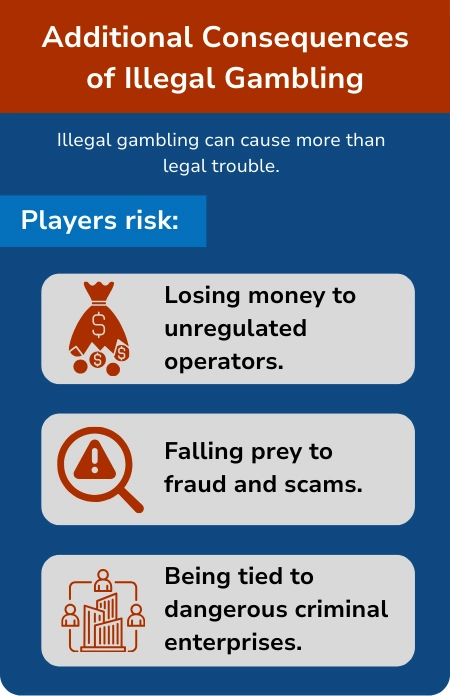
If something’s not on the state’s authorized list, it might not be legal. Treat it with caution or seek legal advice. When players bet in illegal channels and run into trouble, state gaming regulators don't have the authority to step in and assist.
Warning Signs of Illegal Gambling Operations
Illegal gambling is often in plain sight—in gas stations and bars and online.
To stay on the right side of the law:
- stick to licensed casinos, legal sportsbooks, and state-approved lotteries
- avoid placing bets with local bookies, sketchy online sites, or back-room games, and
- don’t host gambling events without understanding your state’s licensing and criminal laws.
Be especially vigilant when gambling online or in places where gambling isn’t the primary business.
Illegal Online Gambling
Many illegal gambling websites operate offshore and pose serious risks to players. These unregulated sites don’t follow state payout standards or consumer protection laws. Common red flags that suggest a website might be unlicensed or operating outside of U.S. law include:
- no visible state licensing details
- minimum age limits of 18
- minimal identity verification
- unrealistic welcome bonuses, or
- an odd domain name (for example, a site ending in .ag or .lv)
If your state allows online gambling, always verify authorized operators through your state gaming commission.
Unregulated Gambling Machines
Illegally operated slot or gambling machines often appear in gas stations, restaurants, and bars. The American Gaming Association estimates there are over 600,000 unregulated machines nationwide. A legitimate machine is typically found inside a licensed facility, where you can find state licensing information displayed, audit stickers on machines, and security cameras focused on machines.
When to Get a Lawyer or Other Help With Gambling
Gambling carries legal, financial, and addiction risks.
Find an Attorney
If you face criminal charges or an investigation, contact a criminal defense attorney right away. Businesses or operators facing audits or licensing sanctions should consult with their business or tax attorneys.
Find Help With Gambling Addiction or Problems
Anyone struggling with a gambling addiction problem, or worried about a loved one, may want to contact 1-800-522-4700—the National Problem Gambling Helpline. State and local resources can be found on the helpline’s website—Help by State.
Other resources include:
Remember, gambling is entertainment. Don't regret the bet.

In This Article
- What Counts as Gambling Under the Law?
- Types of Legal Gambling in the U.S.
- Is Online Gambling Legal?
- What Is the Minimum Age to Gamble?
- Are Office Pools and Home Poker Games Legal?
- Are Fantasy Sports Contests Considered Gambling?
- What Is Illegal Gambling?
- Federal vs. State Gambling Laws and Penalties
- How to Find Out What Types of Gambling Are Legal in Your State
- When to Get a Lawyer or Other Help With Gambling